







White colonial-style houses with lit windows photographed at dusk along a tree-lined street.

Heat Pump Repair in Leonardtown, MD

Tell us about the job

Takes about a minute. No obligation.

RepairHeat PumpSt. Mary's County, MD
Step 1 of 2

What ZIP code is the job in?

Half the homes in St. Mary's County were built in 1992 or later. If your house falls on that side, your heat pump is probably not the oldest part of the system, even if it's acting up now. A newer house usually means the ductwork and electrical behind the unit are in decent shape too, which matters when a tech is tracing down what's wrong. None of that guarantees an easy fix, but it does mean a repair is worth looking at before anyone talks about replacing the whole system.

7 months
October through April, your system heats
4 months
June through September, it cools
29°F
the average winter night it heats against
86°F
the average summer afternoon it cools against
Isometric cutaway illustration of a single-story house showing interior rooms with furniture, an attic duct system connected to an indoor air handler, and an outdoor condenser unit linked by lines along the exterior wall.
Your system heats October through April and cools June through September.

NOAA nClimDiv, 1991–2020 normals

Winters here average a 29°F overnight low, not the single-digit cold that pushes a heat pump to its limit.

Less strain over the years means a breakdown now is more likely a part worth fixing than a system worn out.

Weather here is not what's wearing on your heat pump

192 severe weather events from 2015 to 2024
11% of homes statewide lost power a day or more in 2024
146 damaging wind events from 2015 to 2024
Power here isn't cheapMaryland households paid 17.86 cents per kilowatt-hour in 2024

A heat pump that's struggling still moves refrigerant, still cycles the compressor, even when something underneath isn't right. Keep running it and whatever's wrong gets asked to work harder, not easier. A refrigerant leak is the clearest case. Run the system low on charge and the compressor works to make up for it, which is exactly the part you don't want straining. A failing capacitor is similar. It might still kick the compressor on, just with a hard jolt each time instead of a smooth start, and that wear adds up fast. Ice on the outdoor coil is another one. A little frost during a defrost cycle is normal, but a coil caked in ice means airflow is blocked, and running it that way makes the compressor pull harder against a system that can't breathe. None of this means shut it off and panic. It means a problem that starts small, caught early, usually stays a repair. Left running, it tends to take the compressor down with it.

Get it looked at while it's still a repair

Call someone out now and there's a decent chance it's a capacitor or a low charge, not a dying compressor. That's the kind of repair worth making before it turns into one.

Find a contractor
A man in a cap, dark shirt and tan work pants walks up stone steps toward a dark blue front door, carrying a canvas tool bag, with a potted shrub beside the entry.
A gray heat pump outdoor unit mounted on a concrete pad next to the stone-accented exterior wall of a house.

A newer house usually means a younger system

A house built in the last few decades puts the heat pump itself somewhere in its first owner's hands, not its third. If yours came with the house, check the age against when the house went up. A unit installed with new construction has had an easier climb than one swapped into an older system, and that's one more reason a repair call makes more sense than a replacement quote right now.

The reversing valve is the part unique to this machine

A heat pump has one part an air conditioner doesn't have. The reversing valve switches it between heating and cooling. When it sticks, the system can get stuck blowing cold air in heating mode, or it won't switch over at all. That's a valve problem, not a sign the whole unit is done.
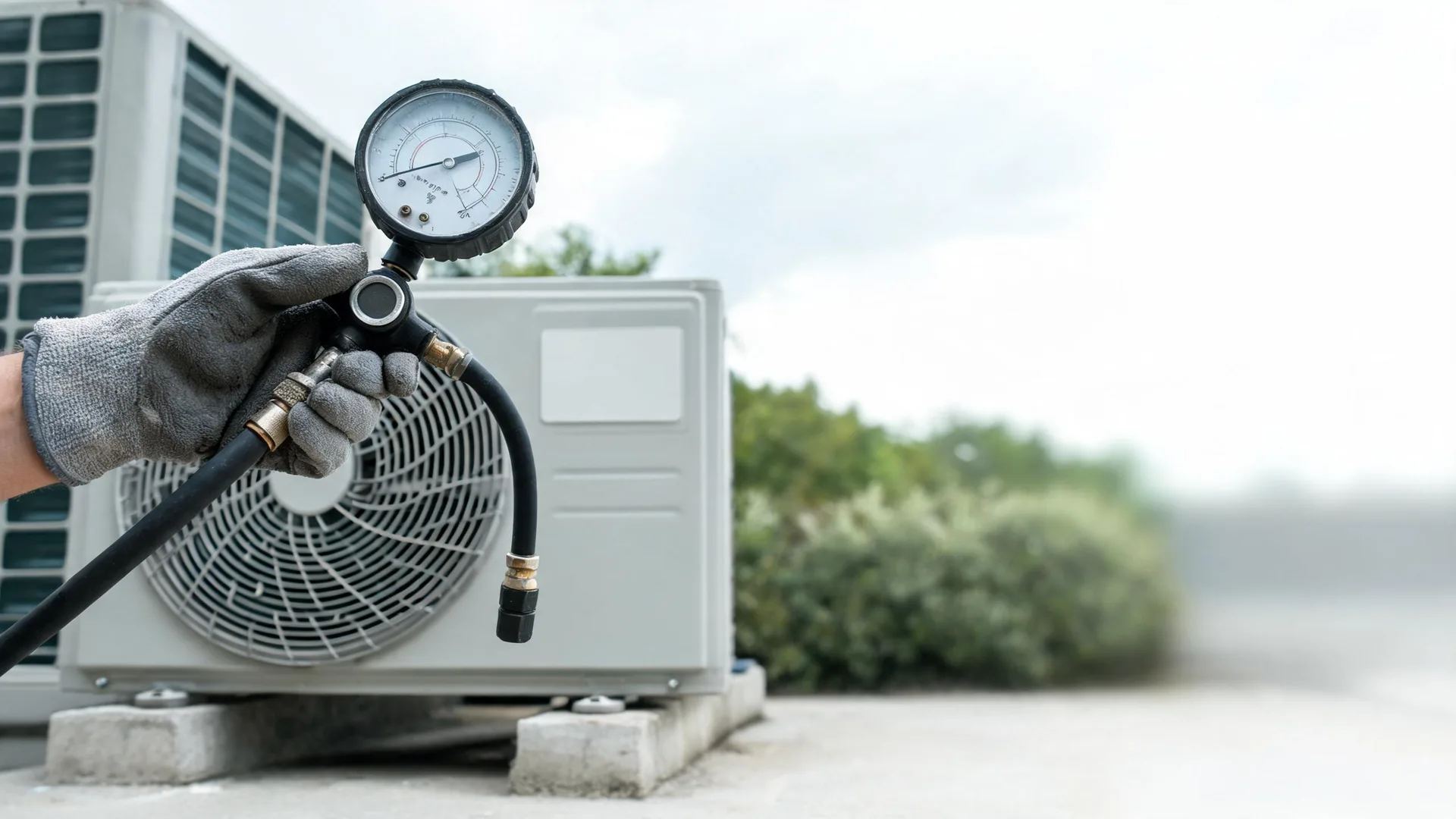
Most failures still trace back to the same few parts

Contactors pit and stop making good contact. Run capacitors weaken and the compressor starts rough instead of smooth. Fan motors seize up or start pulling more current than they should. These parts fail long before a compressor does, and they're the parts worth checking first.

A heat pump that needs a repair usually tells you before any part fully fails. It short cycles, kicking on and off in quick bursts instead of running a full, steady stretch. It blows air that's warm when it should be hot, or barely cool when it should be cold, because the system can't quite hit the temperature it's set for. A hum from the outdoor unit with the fan not turning usually points to a capacitor that can't kick the motor over. A hard rattle or a new buzz that wasn't there before is worth paying attention to, since a healthy heat pump runs fairly quiet. Warm air blowing during heating mode, even for a few minutes at startup, is normal while it switches over. Warm air that stays warm is the reversing valve stuck in the wrong position.

A tech weighing repair against replacement is really asking one question. Is the compressor still good. The compressor is the part that can't be swapped on its own in most cases, and it's the expensive piece to lose. Everything else, the capacitor, the contactor, the reversing valve, the fan motor, gets replaced without touching the compressor at all. A failing capacitor or a stuck reversing valve is a repair almost every time, no matter how old the unit is. What changes the math is a compressor failing on top of a system that's already needed a few other repairs. At that point the question isn't how to fix the part in front of you. It's how many more are left to go. One failed capacitor doesn't put you in that conversation. A compressor on its way out does.