







White colonial-style houses with lit windows photographed at dusk along a tree-lined street.

Heat Pump Repair in Chesapeake Beach, MD

Tell us about the job

Takes about a minute. No obligation.

RepairHeat PumpCalvert County, MD
Step 1 of 2

What ZIP code is the job in?

Half the homes in Calvert County were built in 1990 or later. If yours is one of them, your heat pump is probably newer too, especially if it came with the house. A unit that age isn't worn out. It's usually still well inside its working life, and most problems at this stage come down to one failed part rather than the whole system giving out. That makes repair the right first call, not replacement.

7 months
October through April, your system heats
4 months
June through September, it cools
29°F
the average winter night it heats against
85°F
the average summer afternoon it cools against
Isometric cutaway illustration of a single-story house showing interior rooms with furniture, an attic duct system connected to an indoor air handler, and an outdoor condenser unit linked by lines along the exterior wall.
Your system heats October through April and cools June through September.

NOAA nClimDiv, 1991–2020 normals

Calvert County asks real work of a heat pump, zone 4A with cold winters and humid summers.

Still, a heat pump here isn't fighting extreme heat or extreme cold for months on end, so parts wear slower and a repair holds up.

A heat pump running on a bad part costs you every month here

Power costs 17.86 cents a kWh statewide
120 damaging wind events from 2015 to 2024
14 hail events from 2015 to 2024
Heat pumps break first in the first cold snapHeat runs October through April here, so September is when a weak part gets found.

A failed capacitor or a bad sensor doesn't mean the unit is done. If the system came with the house, get the model and a repair quote before anyone talks replacement. A contractor can check the part against the rest of the unit and tell you if it's one fix or the start of several. That's the only way to know which one you've got.

A heat pump with an easy life is worth repairing

A heat pump that's spent its life out of extreme heat and extreme cold has less wear to show for it. When one part fails here, it's usually just that part. Get it looked at before deciding anything bigger.

Find a contractor
A man in a cap, gray long-sleeve shirt and tan pants walks up stone steps toward a dark blue front door, carrying a waxed canvas tool bag in his right hand.
A gray heat pump outdoor unit mounted on a concrete pad next to the stone-accented exterior wall of a house.

A small problem left running becomes a bigger one

A heat pump with a failing part doesn't idle while it waits for a repair. It keeps cycling, and that's the problem. Low refrigerant doesn't stop the compressor from running, it just makes the compressor work harder to move what little charge is left, and a compressor pushed past what it was built for is how a recharge turns into a compressor job. A failing capacitor works the same way. The motor struggles on every start instead of kicking on clean, and each hard start wears it down a little more. A clogged filter or a blocked outdoor coil is slower but no different. Airflow drops, the system runs longer to move the same amount of heat, and parts rated for normal runtime rack up hours they weren't built for. None of this shows up the day the part fails. It shows up in the days after, while the system keeps running on something that's already going.

The signs are in how it runs, not just whether it runs

A heat pump in trouble doesn't always quit outright. It might run long cycles that never quite satisfy the thermostat, blow air that's not as warm or cool as it should be, or short cycle, kicking on and off every few minutes instead of running a full cycle. Ice building up on the outdoor unit outside of a normal defrost, a hissing or bubbling sound near the lines, or a breaker that trips more than once are all worth a call. These are the system telling you something specific is wrong, not just that it's working hard.
The sound it makes often points to the part

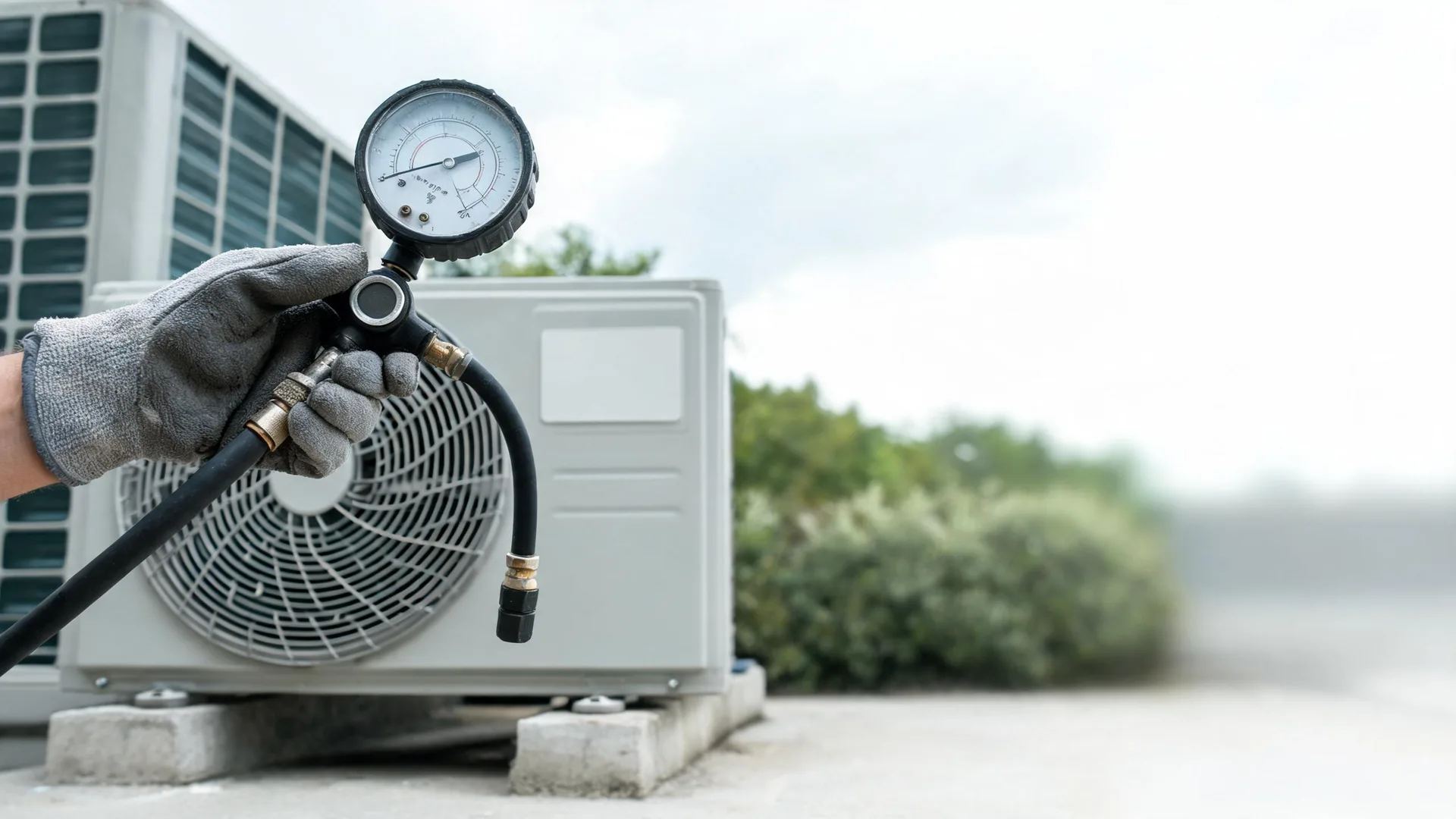
A grinding or screeching from the outdoor unit usually means a motor bearing is going. A clicking that repeats without the system starting points to a failed capacitor or relay. Banging or clanking can mean a loose part inside the compressor housing. A contractor listens for these because they narrow down the problem before the panels even come off. The longer a noise like this runs, the more likely it is that whatever's loose or worn does more damage to what's around it.

Most heat pump failures trace back to a handful of parts. The capacitor gives the compressor and fan motors the jolt they need to start, and it's one of the first things to wear out since it's doing that work every single cycle. A contactor can pit and stick from years of opening and closing, which leaves the outdoor unit running when it shouldn't or not starting at all. Refrigerant doesn't get used up, so if a system is low, it's leaking somewhere, usually at a coil or a fitting. The reversing valve is what lets a heat pump switch between heating and cooling, and when it sticks, the system gets stuck blowing the wrong temperature air. Outside of that, dirt is the quiet killer. A coil caked with debris or a filter packed with dust makes everything downstream work harder than it was built to, and that's often what pushes a weak part the rest of the way to failure.

Repair and replacement both fix the symptom. The difference is what you're paying for next. A new capacitor or contactor solves the problem it caused and nothing else changes, because the rest of the unit was fine before that part gave out and it's fine after. That's the case for repair almost every time a single part fails on its own. Replacement starts to make sense when the failures don't stay single, when one repair turns up a second problem underneath it, or when the part that failed is the compressor itself, since that's most of what a heat pump is. A contractor can tell you which situation you're in by checking what else in the system shows wear before recommending either one.