Two white colonial houses with lit windows and black shutters photographed at dusk along a tree-lined residential street.

Heat Pump Repair in Bowie, MD

Tell us about the job

Takes about a minute. No obligation.

RepairHeat PumpPrince George's County, MD
Step 1 of 2

What ZIP code is the job in?

Zone 4A, not extreme

Bowie sits in a mixed climate that asks real work of both heating and cooling, with humid summers in the mix. That's a workload, not a punishment. A heat pump here isn't fighting the kind of deep cold or sustained heat that wears systems down fast in harsher zones.


So age explains more than weather does

Winter nights average 28°F here, nothing a heat pump built for this region should struggle with. When a unit here is acting up, the cause is usually wear, a part reaching the end of its life, or something that was never quite right, not the climate asking too much of it.

7 months
October through April, your system heats
4 months
June through September, it cools
28°F
the average winter night it heats against
86°F
the average summer afternoon it cools against
Isometric grey-toned illustration of a cutaway house showing interior rooms, ceiling ductwork and an air handler, connected by lines to an outdoor condenser unit beside the building.
Your system heats October through April and cools June through September.

NOAA nClimDiv, 1991–2020 normals

Heat pumps in Bowie run heat from October through April, about seven months straight.

September is the month to get a heat pump checked, before that first cold night in October puts weight on a part that's already failing.

Electricity here runs 17.86 cents a kilowatt-hour, so a struggling heat pump costs more every month it waits

Power costs 17.86 cents a kWh statewide
222 damaging wind events from 2015 to 2024
16 hail events from 2015 to 2024

Half the homes in Prince George's County were built in 1977 or earlier, half in 1977 or later. A heat pump doesn't know which kind of house it's in, and it doesn't matter. What matters is the equipment itself, its age and how it's been looked after. An older home can have a heat pump installed last year. A newer home can have one that's overdue for a part. If your system came with the house, that's worth finding out, since it tells you more about what's likely wearing out than the house's age ever will.

Your heat pump's problem has an ordinary cause, and an ordinary fix

Prince George's County gets its share of wind and the occasional winter storm. None of that runs a heat pump harder than it's built to handle. When one stops working right, the cause is usually something ordinary. A worn part, a failing capacitor, a system that's simply old. A contractor who looks at it now can find what's actually wrong instead of guessing.

Find a contractor
A dark gray heat pump unit mounted on a concrete pad next to a house with gray siding and a stone veneer wall.

What a tech actually checks

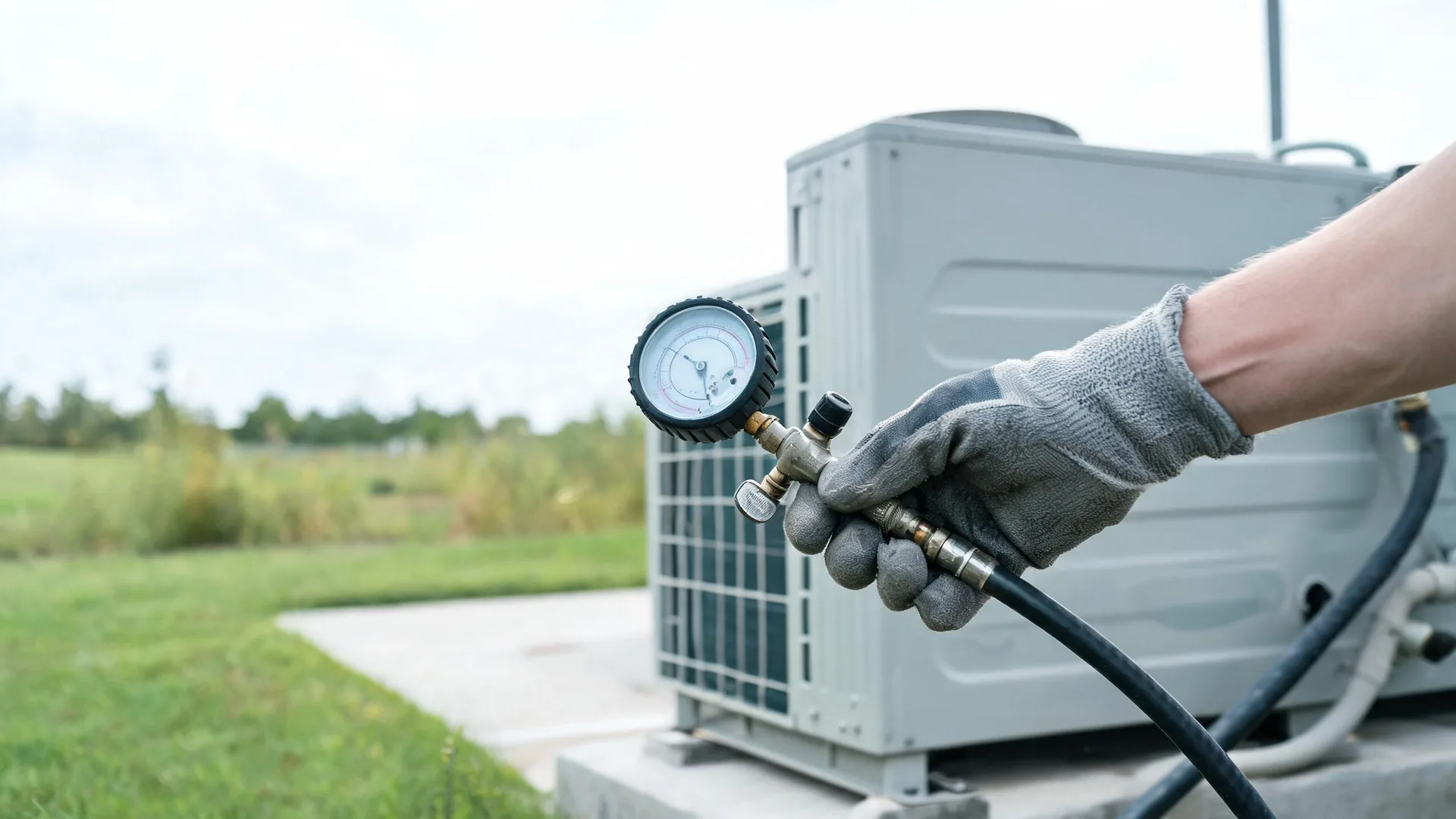
A tech starts outside, checking the outdoor unit for a stuck reversing valve, a failing contactor, or a compressor pulling the wrong amp draw. Refrigerant pressure gets checked at the service ports. A low charge points to a leak somewhere in the lines, and the leak has to be found, not just topped off. Inside, the air handler gets opened up to look at the coil for frost or buildup, and the blower motor gets tested to see if it's moving the air it should. Thermostat wiring and the defrost board get checked too. A bad sensor there can make a heat pump run backward or get stuck heating or cooling when it shouldn't. What a tech is really doing is narrowing down whether the problem is a part that failed outright, a part on its way out, or a system that's lost its charge.

What you can check safely

Look at the outdoor unit first. Clear away leaves, grass clippings or ice so air can move through the coil. Check that the filter inside isn't clogged, since a blocked filter can starve the system of airflow and make it struggle to heat or cool. At the thermostat, make sure it's set to the mode you want and the batteries aren't dead. Check the breaker panel for a tripped breaker. These are the only parts of the system a homeowner should touch.

What to leave alone

Don't open the outdoor unit's panels or touch the refrigerant lines. Don't try to defrost a frozen coil yourself or pour anything on it. If the system is making a grinding or screeching noise, or tripping the breaker repeatedly, turn it off at the thermostat and leave it off. Running a heat pump through an electrical or mechanical fault can turn a simple repair into a compressor replacement.

A heat pump rarely fails all at once. It gives off a sign first, like a coil icing over or a breaker tripping, and that sign is the system telling you something is already wrong. Keep running it and the strain doesn't stay in one place. A failing capacitor makes the compressor work harder to start, and a compressor that strains on every start wears out faster than one that starts clean. A refrigerant leak left alone doesn't just mean less heat. It means the compressor runs low on the lubricant that refrigerant carries through the system, and a compressor running dry is a compressor on its way to full failure. The parts of a heat pump are built to work together at the right pressures and temperatures. Once one part is off, the rest start compensating, and that's how a repair turns into a replacement.

A heat pump is worth repairing when the problem is one part and the rest of the system is still sound. A failed capacitor, a bad contactor, a stuck reversing valve, these are repairs because they don't tell you anything about the compressor itself. Replacement starts to make more sense when the compressor is the thing failing, since that's the most expensive part in the system and the one everything else depends on. Age matters less than how the system has been treated. A unit that's had its coils cleaned and its refrigerant charge kept correct can outlast one that's been run hard with a slow leak nobody caught. The other thing worth asking is how often it's breaking. A system that keeps coming back with a new failure every season is usually telling you it's done, even if each individual fix looks small on its own.