A single-story light gray house with dark shingled roof and black shutters, viewed from a low angle across a green lawn with blurred shrubs in the foreground and trees under an overcast sky.

Furnace Installation in Aberdeen, MD

Tell us about the job

Takes about a minute. No obligation.

New system or replacementFurnace or heatingHarford County, MD
Step 1 of 2

What ZIP code is the job in?

Electricity here runs $52.34 per million Btu

Maryland's electricity costs more than in most states, and that's what an electric furnace or heat pump draws on all winter. A gas furnace sidesteps a lot of that cost, but any electric backup or air handler still runs on that rate.

The furnace you pick decides what you pay every winter after

Two furnaces can look the same size and heat the house the same way, but burn different amounts of fuel to do it. In a state where power costs this much, that difference in efficiency shows up on every bill from the first cold month on.

7 months
October through April, your furnace is on duty
26°F
the average winter night it heats against
80% AFUE
the federal minimum any new unit must meet
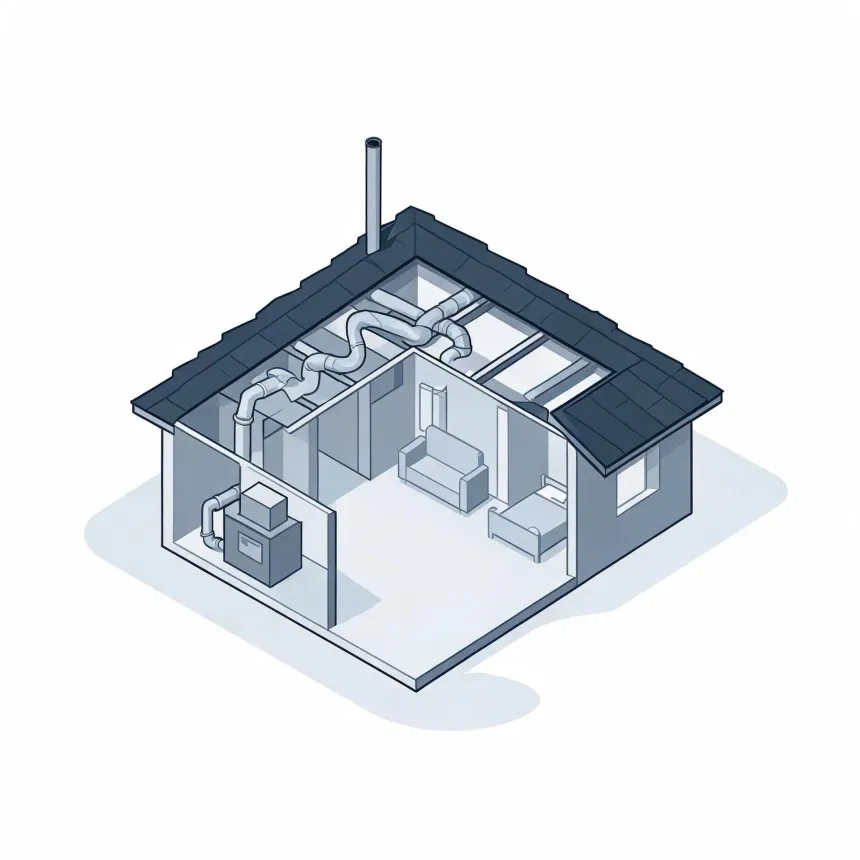
Isometric cutaway illustration of a small house showing a furnace unit connected to ductwork running through the interior and attic, with a chimney on the shingled roof and simple furniture in the rooms.
Your furnace works hardest from November through March.

NOAA nClimDiv, 1991–2020 normals

Aberdeen furnaces run about seven months a year, October through April.

A standard-size, standard-efficiency furnace handles a Harford County winter fine, with nothing here that calls for sizing up.

Harford County's weather tests the power grid, not the furnace

368 severe weather events from 2015 to 2024
11% of homes statewide lost power a day or more in 2024
329 damaging wind events from 2015 to 2024
What Aberdeen homes run onElectricity heats 42.3% of homes in Harford County, gas another 39.1%

Heat starts in October here. September is the month before that, and it's when a furnace install fits in on your own schedule instead of after the first cold night forces the issue. A new furnace put in during September gets run a few times while the weather's still mild, so anything that needs adjusting gets caught early. Wait until the house is already cold and you're working around whoever has time that week, not the week that suits you. Either way the furnace runs about seven months, October through April. Choosing when it goes in is the one part of this that's still up to you.

Any furnace installed here has to meet zone 4A's efficiency minimum

Furnaces sold here have to clear 80 percent AFUE, the federal minimum for this area. That floor goes up to 95 percent for furnaces built from December 2028 on, so a lot more of the gas you buy turns into heat and less goes out the flue. A federal tax credit is available on qualifying high-efficiency equipment, worth checking against whatever model you're comparing.

Find a contractor
A gray gas furnace with attached ductwork and piping installed in an unfinished concrete basement.

Ask what wears out first, not just what heats the house

Ask what happens at the start and end of each heating cycle, since that is where wear shows up first on any furnace. The igniter has to light the gas cleanly every time it is asked to, and a cracked or weak one is the most common reason a furnace stops firing. Ask how the blower is controlled. A variable-speed blower ramps up and down gradually, which puts less strain on the motor and bearings than one that snaps straight to full speed every cycle. Ask about the heat exchanger too. It takes the heat from the flame and passes it into the air moving through the house, and it is built to expand and contract every cycle for years without cracking. A furnace that short-cycles, turning on and off more than it should, puts more stress on all of this than one sized to run in long, steady stretches. Ask what the installer is sizing the furnace to, since a unit sized correctly for the house is the one that avoids that short-cycling in the first place.

Sizing comes from the house, not the old furnace

A contractor works out furnace size from the heat loss of the house itself. That means the square footage, the window area, the insulation, the ceiling height, room by room. The old furnace is a starting point at best. It may have been wrong from the day it went in, or sized for a house that's had windows or insulation changed since. Matching the new unit to the old one just repeats whatever mistake was already there.

Oversized fails quieter, but it still fails

A furnace too big for the house heats the air fast, hits the thermostat setting, and shuts off before it's pulled enough air through the ducts to warm the whole house evenly. Rooms far from the furnace stay cold while the room with the thermostat reads fine. It also means more start-stop cycles over a season, and every cycle wears on the igniter and the heat exchanger. Bigger isn't a safety margin. It's a different way to get this wrong.

The price of a furnace install comes down to what has to happen before the furnace ever gets set in place. The ductwork gets measured against the new unit's airflow, and if the trunk line or the returns are too small for it, that's work beyond just swapping boxes. Venting matters too. A high-efficiency furnace vents through PVC pipe, while an older style ties into a metal flue, and moving from one to the other means running new pipe through the house to the outside. The gas line gets checked against what the new furnace needs to fire at full rate, and the electrical connection gets checked the same way. Where the furnace sits and how far it is from the vent termination, the gas supply, and the return air all add or remove steps. None of this shows up by looking at the old furnace. It shows up once someone's underneath the house or up in the attic looking at what's actually feeding it.

Install day starts with the old furnace coming out. The gas and electrical get shut off and disconnected first, and the old unit gets disconnected from the ducts and vent before it's hauled out. The new furnace gets set in place and leveled, then the ductwork, gas line, and vent pipe all get connected to it one at a time. Each of those gets checked for leaks before the furnace is ever fired, the gas line pressure tested and the duct joints sealed. The electrical and thermostat wiring get tied in last, and only then does the furnace get powered on. With it running, the gas pressure gets measured, the flame gets checked, and the air coming out of the ducts gets checked against what the furnace is rated to produce. The blower gets watched through a full cycle, on and off, before anyone calls it finished.