
White colonial-style houses with lit windows photographed at dusk along a tree-lined street.

Heat Pump Repair in Westminster, MD

Tell us about the job

Takes about a minute. No obligation.

RepairHeat PumpCarroll County, MD
Step 1 of 2

What ZIP code is the job in?

What broke matters less than where it sits

A failed capacitor or run contactor is a straightforward fix on almost any heat pump. A failed compressor or reversing valve is a different question, because the cost of that repair starts to compete with putting the money toward a new system. Ask the contractor what actually failed before deciding how to think about it.

A repair that keeps coming back is telling you something

One breakdown is just a breakdown. A heat pump that keeps calling a tech back, season after season, is usually wearing out across the board rather than suffering from one bad part. In that case the next repair just buys time until the next failure, and that pattern is worth more than any single diagnosis.

7 months
October through April, your system heats
3 months
June through August, it cools
25°F
the average winter night it heats against
84°F
the average summer afternoon it cools against
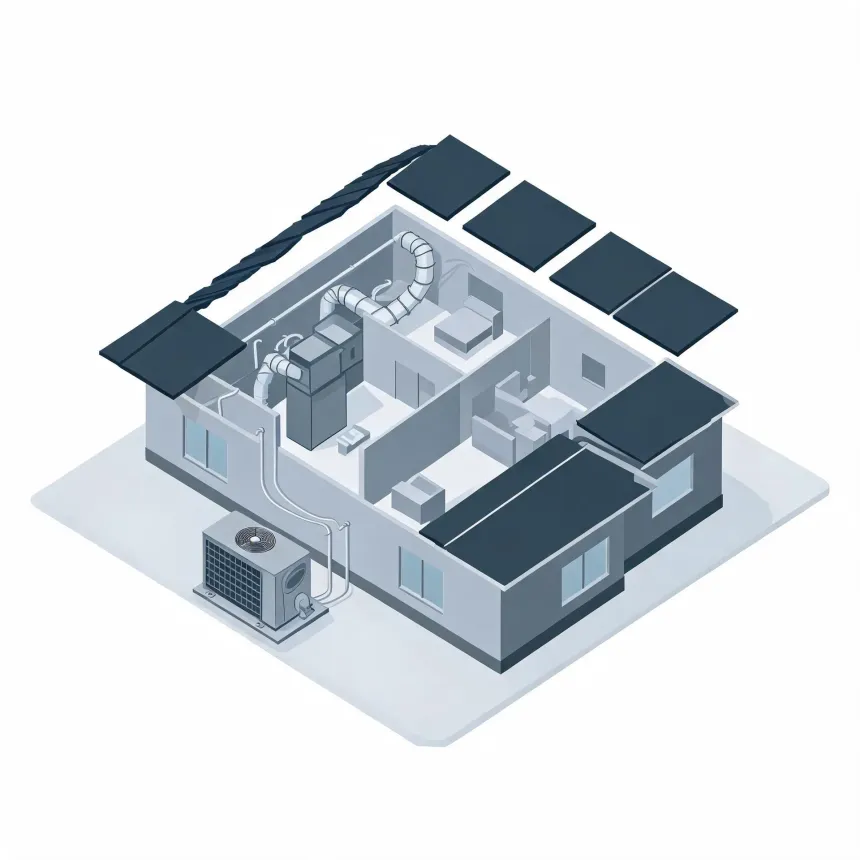
Isometric grayscale illustration of a cutaway single-story house showing interior rooms, ductwork and an air handler, an exterior condenser unit connected by lines, and dark solar panels on the roof.
Your system heats October through April and cools June through August.

NOAA nClimDiv, 1991–2020 normals

Westminster asks a heat pump to run both ways, into real cold and real humidity, but it's not pushing the machine to its limits either way.

A heat pump that's been given a fair winter is usually a heat pump worth repairing.

A broken heat pump costs more here every day it runs wrong

Power costs 17.86 cents a kWh statewide
173 damaging wind events from 2015 to 2024
13 hail events from 2015 to 2024

So when a contractor gives you a diagnosis on your heat pump, that fair winter history is worth factoring in. Ask what actually failed and how the rest of the unit looked while they were in there. A worn contactor or a weak capacitor on a machine that has only had to handle an average Carroll County winter is a straightforward yes. Overnight lows here average 25°F across December, January and February, which is real cold but not extreme cold, and a heat pump built for this climate is not spending its life maxed out. Less strain over the years means a repair is more likely to be money well spent, rather than one fix in a string of them.

It's usually worth repairing

It has an easier job here than in most places, so your heat pump is often in decent shape. Repair is usually worth it.

Find a contractor
A gray heat pump outdoor unit mounted on a concrete pad next to the stone-accented exterior wall of a house.

Half the county is building newer, and that cuts both ways in your favor

Half the homes in Carroll County were built in 1983 or later. If yours is one of them, the heat pump may be original to the house or it may be a replacement already, there's no way to know that from the house alone. Either way, a system that hasn't been run hard for decades is a better bet for repair than one that has. Ask the contractor how old the unit actually is before you decide what to do with it.

It's not heating or cooling like it should

A heat pump that blows air but never gets the house to temperature is usually losing refrigerant or struggling with a failing compressor. One that only manages lukewarm air in heating mode may have switched into backup heat and never switched back, which is worth mentioning to the contractor on its own.

The outdoor unit is telling on itself

Ice building up on the outdoor coil beyond a normal defrost cycle means the defrost board, a sensor, or the reversing valve isn't doing its job. A compressor that hums but won't start, or clicks and shuts off on its own, is usually tripping on a failed capacitor or a motor winding on its way out. Either one is worth a same-week call rather than a wait and see.

Most heat pump failures trace back to a handful of parts, and the reversing valve is the one unique to this machine. It's what switches the system between heating and cooling, and when it sticks, the unit keeps running but stops doing what the thermostat asked for. Capacitors and contactors fail the same way they would in any air conditioner, from age and from the daily cycle of starting and stopping the compressor. The defrost board and its sensors are worth asking about too, since their job is knowing when to melt ice off the outdoor coil, and a bad sensor can leave frost building up with nothing telling the system to clear it. Refrigerant loss is rarely sudden. It's almost always a slow leak at a fitting or coil, showing up first as weaker heating or cooling long before the unit stops working altogether.

A diagnostic visit starts outside, at the unit itself. A tech will check refrigerant pressure, look at how the compressor is drawing power, and watch a defrost cycle if one happens to run while they're there. Inside, they'll check the air handler or furnace coil, since the indoor side has its own fan motor and sensors that can fail just like the outdoor ones. Expect them to pull the cover off the control board and look for burned contacts, loose wiring, or a capacitor that's swollen instead of flat. If the system has been throwing a fault code, that code usually points to a likely part rather than leaving the tech guessing. The goal is to find the part that actually failed before replacing anything, not to swap parts until something works.