






White colonial houses with lit windows photographed at dusk along a tree-lined residential street.

Heat Pump Repair in Elkton, MD

Tell us about the job

Takes about a minute. No obligation.

RepairHeat PumpCecil County, MD
Step 1 of 2

What ZIP code is the job in?

Zone 4A means real heating and real cooling, not one long easy season. Your heat pump works through winters that average 27°F overnight and summers that push back the other way. That's steady work, but it's not punishing work, and the wear shows the difference. A unit here is more likely to fail because of a worn capacitor or a dirty coil than because the compressor gave out from years of strain. That's usually worth fixing.

7 months
October through April, your system heats
4 months
June through September, it cools
27°F
the average winter night it heats against
85°F
the average summer afternoon it cools against
Isometric cutaway illustration of a house showing attic ductwork, an indoor air handler, furnished rooms, and an outdoor condenser unit connected by lines along the exterior wall.
Your system heats October through April and cools June through September.

NOAA nClimDiv, 1991–2020 normals

Half the homes in Elkton were built in 1987 or later.

A heat pump that came with a newer house still has years in it, and that's worth fixing.

At 17.86 cents a kilowatt-hour, a heat pump running wrong costs you all summer

Power costs 17.86 cents a kWh statewide
Climate zone 4A
Cooling runs June through September

September is worth paying attention to here. Heat runs October through April, and whatever was already weak in the system, a tired capacitor, a low charge, a contactor on its way out, tends to hold together through the mild weeks and fail on the first morning that asks it to actually work hard. Same thing happens in May, the month before cooling starts in June. A repair looked at before the switch gets fixed on your schedule. Wait for the first cold snap and it gets fixed on the system's.

A heat pump problem here is usually a part, not storm damage

Cecil County gets its share of wind, and a handful of winter storms each year. None of that is what wears out a heat pump here. The weather that matters to this system is the ordinary swing between summer and winter described above, not storms. So when one acts up, the cause is usually a part that wore out on schedule, not damage. That's a straightforward fix, and worth making.

Find a contractor
A man in a faded olive work shirt and dark trousers climbs porch steps toward a navy front door, carrying a green canvas tool bag in his right hand, with a potted shrub in a blue planter beside the door.
A gray heat pump outdoor unit mounted on a concrete pad next to a residential house with lap siding and stone accents.

A steady year, not a hard one

This heat pump has been running the same hours every homeowner's has in this county, no more. The time-lapse shows one day, but stretch that across a year and the load stays even, the cold stretch in winter, the push back the other way in summer. Nothing here runs it into the ground. So when something finally gives out, the smart move is to find the part and replace it, not start pricing a new system.

The reversing valve is the part unique to this machine

A heat pump fails in most of the same ways an air conditioner does, but it also has a reversing valve that switches it between heating and cooling. When that valve sticks, the system can get stuck running one way, or blow air that's not what you set the thermostat to. It's not the most common failure, but it's one a straight AC never has to deal with.
Most failures are still the ordinary ones

Outside of the reversing valve, the usual suspects are still the usual suspects. A capacitor loses its charge. A contactor pits and stops making good contact. A coil cakes up with dirt until it can't shed heat. Refrigerant runs low from a slow leak. None of that is specific to a heat pump. It's what wears out on any outdoor unit that runs hard in both directions, and it's the kind of failure a tech can usually find fast.

Before calling anyone, look at the thermostat first. Make sure it's set to heat or cool as needed and the temperature is actually asking the system to run. Check the outdoor unit for anything blocking it, leaves, ice, a cover left on, since airflow in and out of that unit matters as much as the airflow inside. Go to the air handler or furnace closet and check the filter. A filter clogged with dirt chokes the whole system and can look like a much bigger problem than it is. Check your breaker panel for a tripped breaker before assuming the worst, since heat pumps run on dedicated circuits that do trip. If the outdoor fan isn't spinning but you can hear a hum, don't keep resetting it. That's a sign worth describing to whoever comes out, not something to force.

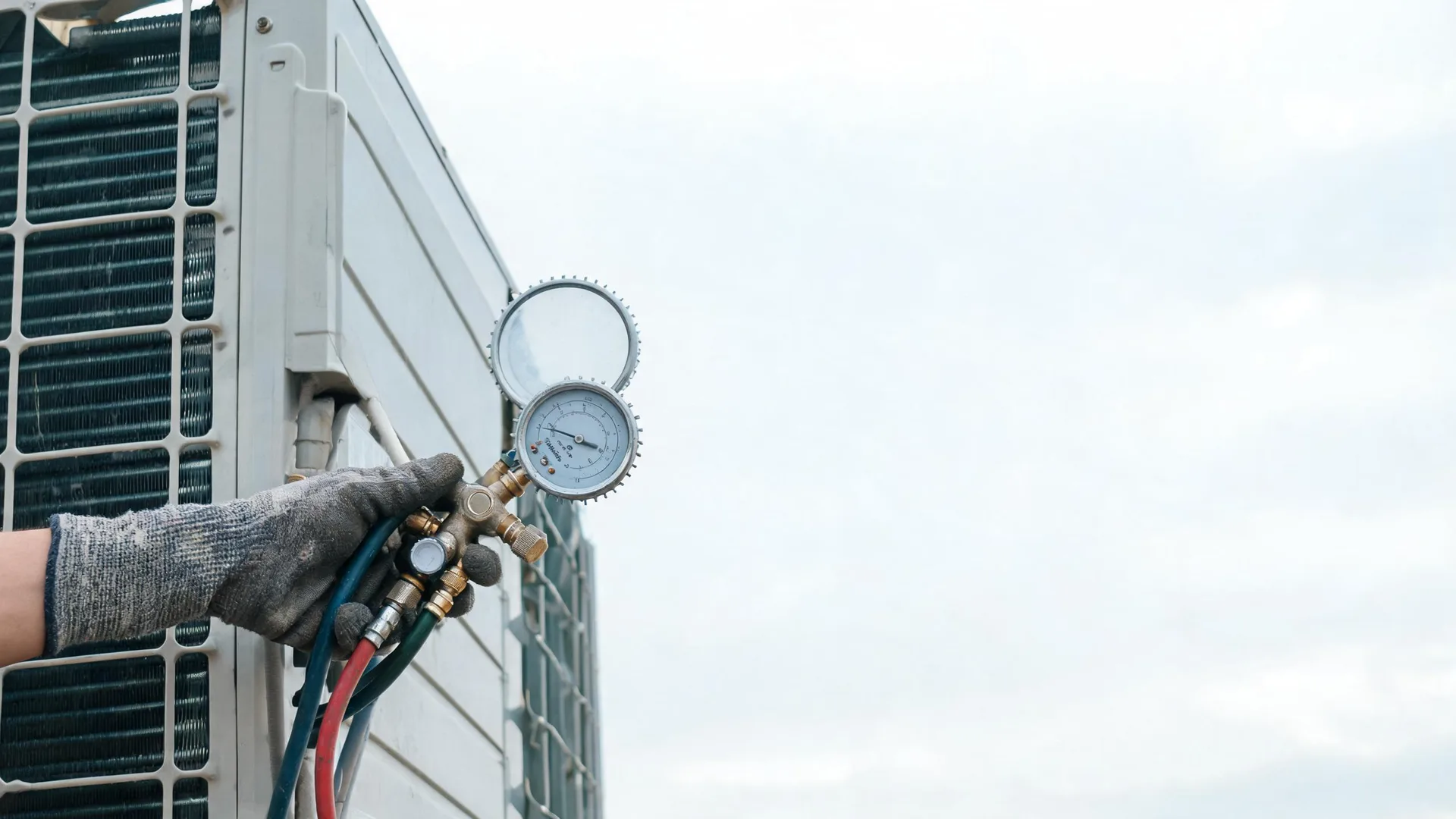
A diagnostic starts outside, not with a toolbox. The tech checks the thermostat call first, makes sure the system is actually being told to run and in which mode, before touching the outdoor unit. From there it's the reversing valve, the capacitor, the contactor, the coil, checked in whatever order the symptoms point to rather than straight down a list. A failing capacitor shows up as a hum with no spin, or a compressor that struggles to start. A stuck reversing valve shows up as warm air when you asked for cold, or the reverse. Refrigerant charge gets checked with gauges, not guessed at, since both too little and too much cause real damage over time. Most of this takes less time than people expect, because the symptom usually points straight at the part before the tech even opens the panel.