






White colonial houses with lit windows photographed at dusk along a tree-lined residential street.

Heat Pump Repair in Chestertown, MD

Tell us about the job

Takes about a minute. No obligation.

RepairHeat PumpKent County, MD
Step 1 of 2

What ZIP code is the job in?

A heat pump that needs a repair now and then is normal. What matters is what's failing and how often. A bad capacitor, a stuck reversing valve, a failed contactor, these are wear parts and fixing them makes sense almost always. It's a different story when the compressor itself is going, or when the coil has a refrigerant leak that keeps coming back after it's patched. Age matters too, because a system near the end of its expected life that needs a major part is a different decision than the same repair on a newer unit. If a contractor tells you the compressor is failing, ask straight out whether putting money into it still makes sense.

7 months
October through April, your system heats
4 months
June through September, it cools
28°F
the average winter night it heats against
86°F
the average summer afternoon it cools against
Isometric illustration of a cutaway single-story house showing interior ductwork and an air handler connected by lines to an outdoor condenser unit on a pad beside the building.
Your system heats October through April and cools June through September.

NOAA nClimDiv, 1991–2020 normals

Kent County asks real work of a heat pump in both directions, winter nights averaging 28°F and summers running humid.

A heat pump working a moderate load like that usually holds up well, so a repair is worth making.

Nothing here works a heat pump harder than usual, so the usual fix is likely the right one

Half the homes here were built by 1978
98 damaging wind events from 2015 to 2024
Winter nights average 28°F

October is when heat first gets asked to work here, and it's also when a weak part finally gets found out. A reversing valve that was sticking a little in September can fail outright the first cold week it has to switch on every cycle. A capacitor that was marginal all summer can quit the moment the compressor has to start up against a cold coil. If a heat pump gave any sign of trouble last season, before the first heat of October is the time to get it looked at, not after the first hard freeze.

A heat pump with a moderate load here is usually a heat pump worth repairing

Most of what breaks in a heat pump working a load like this is a part worth fixing, not a sign the system is done. If yours is acting up, getting the actual cause found is what settles it, repair or otherwise.

Find a contractor
A man in a dark cap, gray long-sleeve shirt and brown work pants climbs porch steps toward a navy front door, carrying a canvas tool tote with tools in its pockets, beside a potted evergreen shrub in a blue planter.
A gray air-source heat pump mounted on a concrete pad next to a house with gray vinyl siding, surrounded by gravel and flanked by green shrubs and white hydrangea flowers.

What a heat pump tells you before it quits

A heat pump runs in both directions, so it has more ways to show it's struggling than a furnace does. In heating mode, warm air from the vents that isn't actually warm, or air that feels cool to the touch, points at the reversing valve or a refrigerant charge that's low. Frost built up on the outdoor coil that doesn't clear during the defrost cycle means that cycle isn't working right. Short cycling, where the system kicks on and off every few minutes instead of running a full cycle, wears on the compressor every time it happens. A system that runs and runs without hitting the temperature on the thermostat is losing the fight somewhere, often a coil that needs cleaning or a charge that's dropped. Listen for it too. A hard clunk when the system switches between heating and cooling is usually the reversing valve. A hum with no startup is a failing capacitor or contactor. None of these fix themselves, and all of them get worse the longer the system keeps running that way.

A low charge gets lower

A heat pump low on refrigerant doesn't stay at the same level. The leak that caused it keeps leaking, and the compressor keeps working against a charge that's thinner every week. A compressor built to pump refrigerant ends up pumping mostly oil and vapor instead, and that's what burns it out. The repair that would have been a leak patch and a recharge turns into a compressor replacement.
A stuck reversing valve won't fix itself

If the valve is sticking, running the system more doesn't loosen it up. Every cycle that fails to switch properly puts the compressor under a load it isn't built to carry in that position. A valve caught halfway can send liquid refrigerant back to the compressor instead of vapor, and that's a hit it doesn't recover from. The longer it runs stuck, the more likely the fix becomes bigger than a valve.

Before calling anyone, a few things are worth checking yourself. Make sure the thermostat is actually set to heat or cool, not just on, and that the set temperature is past the room temperature. Go look at the outdoor unit. If it's covered in ice, buried in snow, or packed against leaves and debris, that airflow problem could be the whole issue. Check the air filter. A filter clogged with dust chokes the system's airflow and can look like a much bigger problem than it is. Check the breaker box, because a tripped breaker on either the indoor or outdoor unit will shut the whole system down and looks like nothing happened at all. None of this fixes a bad capacitor or a low charge, but it rules out the simple stuff first.

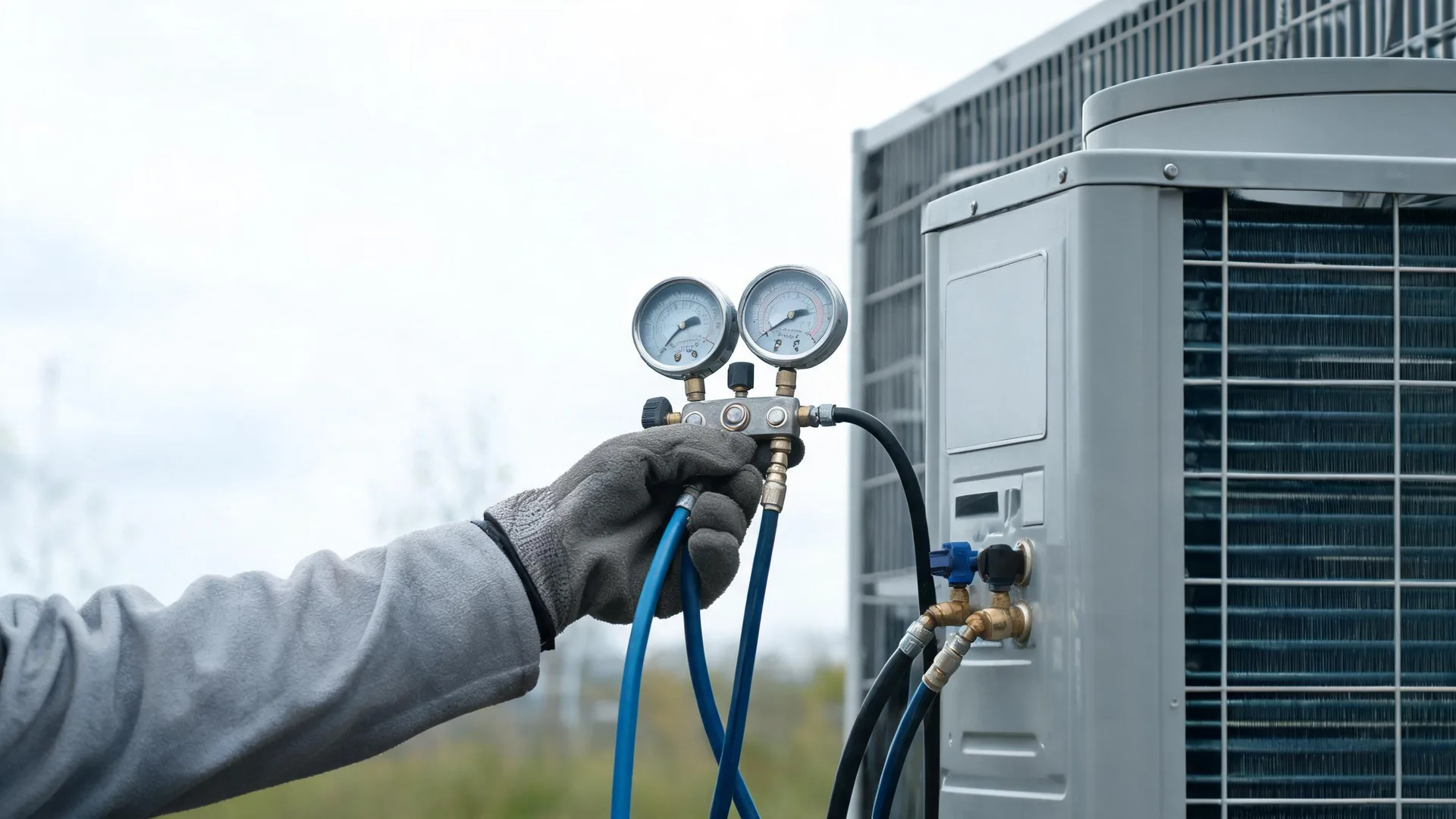
A diagnostic visit starts outside at the unit itself, checking refrigerant pressure, electrical draw, and whether the reversing valve actually switches when it's told to. Gauges on the lines show whether the charge is right or low. A low reading means the next question is finding where it's leaking out. Inside, the tech checks the air coming off the vents against what the thermostat is calling for. A gap between those points at specific parts rather than the system in general. Electrical components get tested under load, not just looked at, since a capacitor or contactor can look fine sitting still and fail the moment it has to work. The visit ends with a straight answer about what's failing, what it takes to fix it, and whether that repair makes sense for the system's age and condition.