







A weathered white picket fence runs along a grassy lawn in front of a row of two-story wood-sided houses with porches and gabled roofs, beneath large leafy trees.

Heat Pump Repair in Annapolis, MD

Tell us about the job

Takes about a minute. No obligation.

RepairHeat PumpAnne Arundel County, MD
Step 1 of 2

What ZIP code is the job in?

Heat pumps in Annapolis run heat October through April and cooling June through September, so May and September are the two months right before the load changes. A part that was just barely getting by in mild weather often gives out once the system has to work harder. If yours is short cycling, blowing air that is not warm or cool enough, or not responding to the thermostat, that usually means something was already weak before the season started. Catching it in those first weeks is easier than waiting until the system is running flat out.

7 months
October through April, your system heats
4 months
June through September, it cools
29°F
the average winter night it heats against
86°F
the average summer afternoon it cools against
Isometric cutaway illustration of a single-story house showing interior ductwork, an indoor air handler, and an outdoor condenser unit connected by lines along the exterior wall.
Your system heats October through April and cools June through September.

NOAA nClimDiv, 1991–2020 normals

Annapolis gets its share of wind and hail, but that's weather, not a reason your heat pump is struggling.

Whatever it's doing, a weak capacitor or low refrigerant charge explains it more often than the county ever will.

Annapolis sees its share of storms. That's not why your heat pump is acting up.

286 severe weather events from 2015 to 2024
11% of homes statewide lost power a day or more in 2024
248 damaging wind events from 2015 to 2024
A lot of Anne Arundel is newer than you'd thinkHalf the homes in Anne Arundel County were built in 1983 or later.

Maryland electricity ran 17.86 cents a kilowatt-hour in 2024, higher than a lot of the country pays. A heat pump that's struggling, short cycling, running its strip heat more than it should, pulling in warm air it can't condition right, draws more power to do less. That cost shows up on next month's bill whether you've called anyone or not. Fixing the actual problem is what stops it.

If your heat pump came with a newer house, repair is usually the call

Half the homes in Anne Arundel County were built in 1983 or later. A system that came with a house that age hasn't used up its working life yet. That's a reason to get the actual problem found and fixed, not to start pricing a replacement.

Find a contractor
A man in a cap, dark jacket and tan work pants walks up concrete steps toward a dark blue front door, carrying a canvas tool bag at his side.
A white mini-split heat pump outdoor unit mounted on a concrete pad beside a gray-sided house, surrounded by gravel and green shrubs.

What you can check yourself before the call

Before anyone comes out, check the thermostat batteries and the setting itself. A thermostat stuck on the wrong mode will make a heat pump blow air that feels wrong even though nothing is actually broken. Next, go look at the outdoor unit. If the coil is packed with leaves, grass clippings or ice, that alone can cause weak heating or weak cooling, and clearing debris off the top and sides is safe to do yourself. Check the air filter too. A filter clogged with dust chokes airflow on both the heating and cooling side, and that alone can cause short cycling. Look at the outdoor unit's base and make sure it hasn't tipped or sunk on one side, since that can strain the lines over time. What you should not touch is the refrigerant lines, the electrical disconnect, or anything inside the indoor air handler's cabinet. Low charge and failing capacitors are common causes of exactly these symptoms, and both need gauges and training to deal with safely.

A weak part doesn't rest, it just gets pushed harder

A heat pump that's struggling still has to meet the thermostat setting, so it leans on whatever is left working. A failing capacitor makes the compressor draw harder to start each cycle. A low refrigerant charge means the compressor runs longer to move the same heat. Neither of those gets better with time. The part just wears toward the point where it quits.
One bad part can take others down with it

A compressor is built to run with the right charge and the right electrical support behind it. Ask it to run low on refrigerant, or off a weak capacitor, and it runs hotter than it should, cycle after cycle. That heat is what shortens a compressor's life. Letting the small failure go is what turns it into a bigger one.

A reversing valve is what lets a heat pump switch between heating and cooling, and when it sticks, the system gets stuck too, running one mode when the thermostat is asking for the other. Contactors and capacitors wear out from the plain act of starting the compressor over and over, year after year, in both seasons. Outdoor fan motors fail from age and from running in weather, and once that fan stops moving air across the coil, the system can't do its job in either direction. Defrost boards and sensors fail quietly, and when they do, the outdoor coil ices up and stays iced instead of clearing itself the way it should. None of these wait for a convenient month. They go when they've had enough starts and enough hours, heating or cooling, and the only thing the season decides is how hard the system was leaning on them at the time.

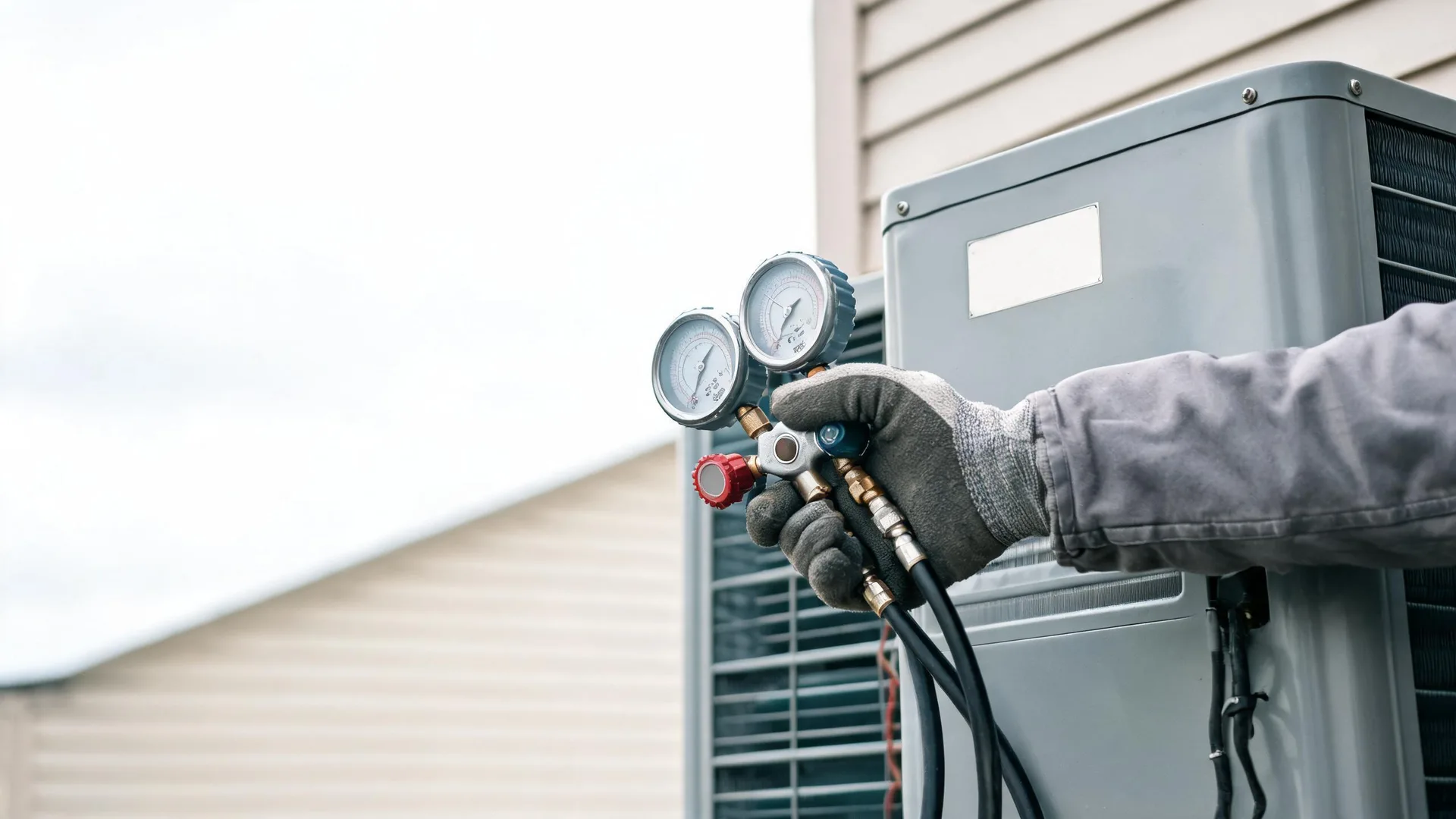
A diagnostic call starts outside, with the system running, so the tech can see what it's actually doing and not just what it's doing wrong. Gauges go on to check refrigerant pressure, since that one number tells on a lot of other problems at once. Electrical testing comes next. The capacitor, the contactor, the compressor's amp draw while it's working under load. Indoors, the tech checks the air filter and whether the system is actually running in the mode the thermostat thinks it's in, since a stuck reversing valve can fool a homeowner into blaming the thermostat. Airflow gets checked too, because weak airflow can mimic a refrigerant problem and send someone chasing the wrong fix. The point of all this is finding the one part that's actually failing, not swapping parts and hoping.