





An outdoor heat pump unit mounted on a concrete pad beside a house with beige siding and a landscaped garden bed.

Heat Pump Repair in Aberdeen, MD

Tell us about the job

Takes about a minute. No obligation.

RepairHeat PumpHarford County, MD
Step 1 of 2

What ZIP code is the job in?

Half the houses in Harford County were built in 1986 or later. If yours is one of them, the heat pump likely isn't that old either, and most problems at that age come down to one part failing, not the system wearing out. A bad capacitor, a low charge, a stuck reversing valve, these get fixed on the spot. Replacing a heat pump that still has years in it rarely makes sense when the repair is this straightforward.

7 months
October through April, your system heats
4 months
June through September, it cools
26°F
the average winter night it heats against
85°F
the average summer afternoon it cools against
Isometric cutaway illustration of a small house showing interior ductwork and an air handler connected by lines to an outdoor condenser unit on a pad beside the building.
Your system heats October through April and cools June through September.

NOAA nClimDiv, 1991–2020 normals

Winter nights in Harford County average 26°F, not far below freezing, so a heat pump here isn't fighting extreme cold to keep a home warm.

A heat pump working moderate winters and humid summers wears slower, so a repair on one in Aberdeen is usually worth making.

At 17.86 cents a kilowatt-hour, a heat pump running wrong costs you every month it goes unfixed

Power costs 17.86 cents a kWh statewide
329 damaging wind events from 2015 to 2024
10 hail events from 2015 to 2024

October is when heat pumps here switch over to heat, and that first cold snap is when a weak part finally gives out. A reversing valve that was sticking in September will show it the first night it has to hold heat instead of cooling. Same with a contactor or capacitor that's been marginal all summer. The system ran fine on cooling because the load was lighter, then October asks more of it and something that was already worn quits. If your heat pump is acting up right as the weather turns, that timing isn't a coincidence, and it's usually one part, not the whole unit.

Harford County weather doesn't put extra strain on a heat pump

Harford County has had its share of wind and a few winter storms over the past decade, but none of that runs a heat pump harder than normal. A power outage can shut one down, and it should start back up on its own once power is back. Outside of that, weather here isn't the reason yours is acting up. One worn part is still the likely story, and that's worth having someone check before you think about replacing the system.

Find a contractor
A gray outdoor HVAC unit mounted on a concrete pad beside a house with gray lap siding and a stone foundation.

Call a repair in, not a replacement

If the house was built in 1986 or later, get the part fixed and move on. A heat pump that age has a compressor built to run another decade or more, and nothing about a stuck reversing valve or a bad capacitor changes that. Ask whoever comes out what's actually worn before you let them quote you a new system.

It's blowing air that isn't the right temperature

A heat pump stuck on cool air when it should be heating, or warm air during a cooling cycle, usually means the reversing valve isn't shifting the way it should. Sometimes it's partway stuck, so you get air that's just lukewarm instead of clearly wrong. That valve doesn't fix itself, and running the system while it's stuck puts strain on the compressor.
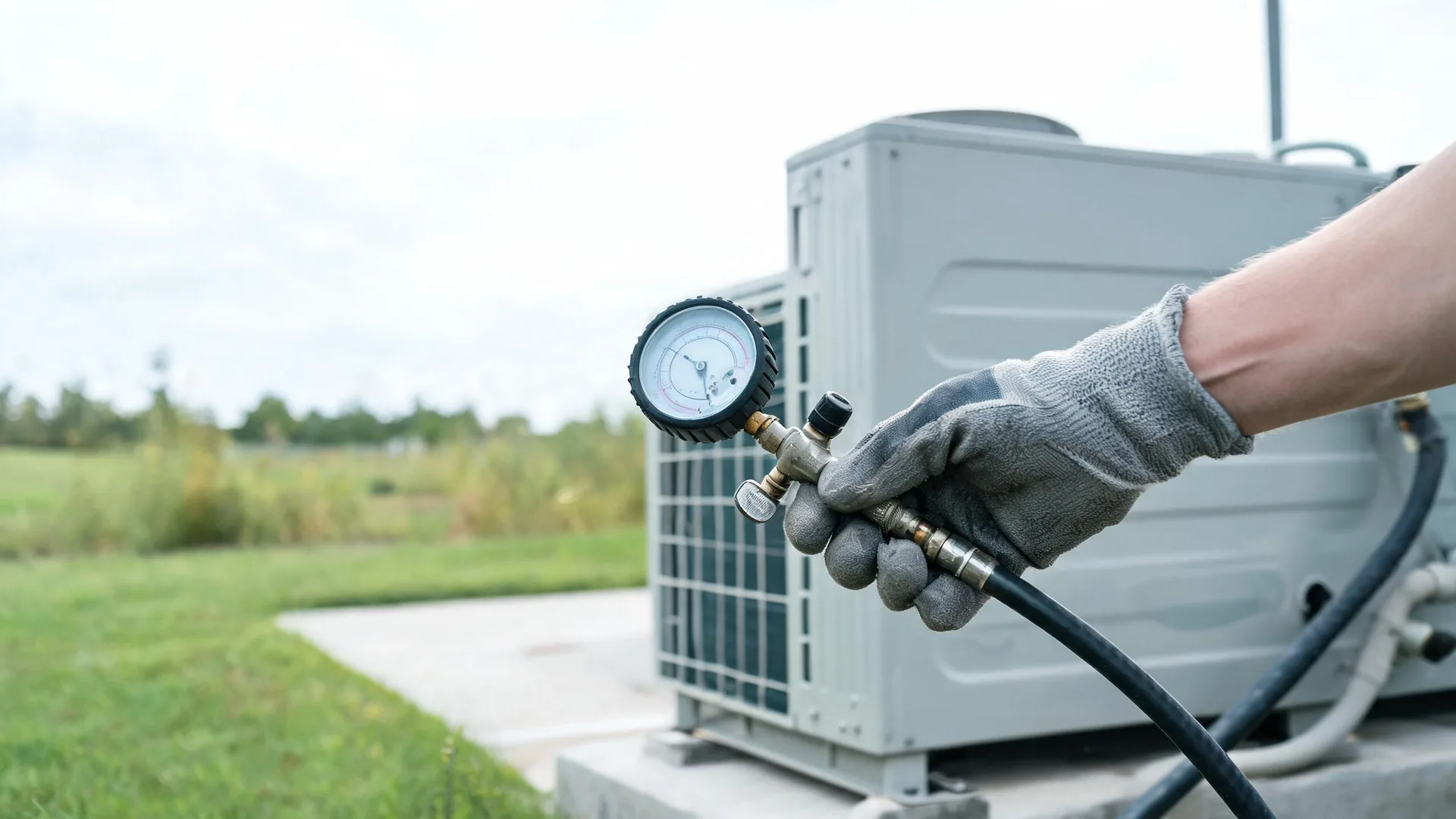
It's short cycling or won't stop running

A heat pump that kicks on and off every few minutes is usually dealing with a bad capacitor, a dirty sensor, or a low refrigerant charge. One that runs constantly and never seems to catch up is often low on charge or has a coil too dirty to move heat properly. Either way, the system is working harder than it needs to, and a compressor run that hard for long enough is what turns a small repair into a bigger one.

A reversing valve that's partway stuck won't get better by waiting, it gets worse, because every cycle the compressor pushes against a valve that isn't fully seated. Same with a low charge. The system doesn't run low gracefully, it runs harder to make up for it, and that extra work falls on the compressor every single cycle. A dirty coil does the same thing from the other side, making the system move more air or run longer to get the same heat transfer. None of this damage shows up right away. It shows up as a compressor that draws too hard and finally quits, which is a different repair entirely from the part that started it. Catching the capacitor or the valve early is what keeps this a small job.

A technician checking a heat pump that's acting up isn't guessing whether it's worth fixing, he's checking which part failed. A compressor is the one that changes the math, since a bad one costs close to as much as starting over. Everything else, the capacitor, the contactor, the reversing valve, the fan motor, gets swapped out on its own without the compressor ever coming into it. So the question worth asking isn't how old the system is, it's what actually quit. If the compressor is still turning and holding pressure the way it should, the repair is just the part that failed, nothing more.