A two-story red brick house with black shutters and a dark roof sits on a mown lawn behind a long dry-stacked stone wall, framed by large deciduous trees under an overcast sky.

Heat Pump Maintenance in Mountain Lake Park, MD

Tell us about the job

Takes about a minute. No obligation.

Tune-up, service, or cleaningHeat PumpGarrett County, MD
Step 1 of 2

What ZIP code is the job in?

The system is talking to you

A heat pump that's struggling gives you warning before it quits. Short cycling, air coming out barely warm or barely cool, ice building up on the outdoor unit when it shouldn't be there, a hissing or grinding sound that wasn't there before. Any one of these means something inside is working harder than it should, and that's worth a look before the part it's straining actually fails.


What a check actually catches

A technician checks refrigerant charge, tests the capacitor and contactor, cleans the outdoor coil, and makes sure the reversing valve is switching the way it should. These are the parts that quietly wear down and cause the symptoms above. Catching a weak capacitor or a coil caked with debris during a check means it gets fixed on your schedule, not in the middle of a cold night when the system finally gives out.

Half the homes in Garrett County were built in 1982 or later.

A heat pump that age has years left in it, and a yearly check is what keeps it getting there.

Heat pump works nine months straight here. August is when to get it checked.

Cooling runs July through August
Heat runs September through May
63 damaging wind events from 2015 to 2024
Easier duty hereWinter nights average 21°F, cold enough to run the heat pump hard, but Garrett County doesn't see the extreme swings that wear a system out fast.

Maryland electricity ran 17.86 cents per kilowatt-hour in 2024, higher than a lot of the country. A heat pump that's low on refrigerant or pulling air through a dirty coil has to run longer to do the same job, and every extra minute shows up on the meter. A yearly check catches that kind of drag before it becomes a habit the system can't break. Keeping the unit running the way it was built to run is what keeps that cost down.

Keep it in good shape

If your system is fairly new, a yearly check keeps it in good shape for longer.

Find a contractor
A man in a dark work shirt, tan cargo pants and boots, seen from behind, climbs porch steps toward a navy front door while carrying a worn leather tool bag.
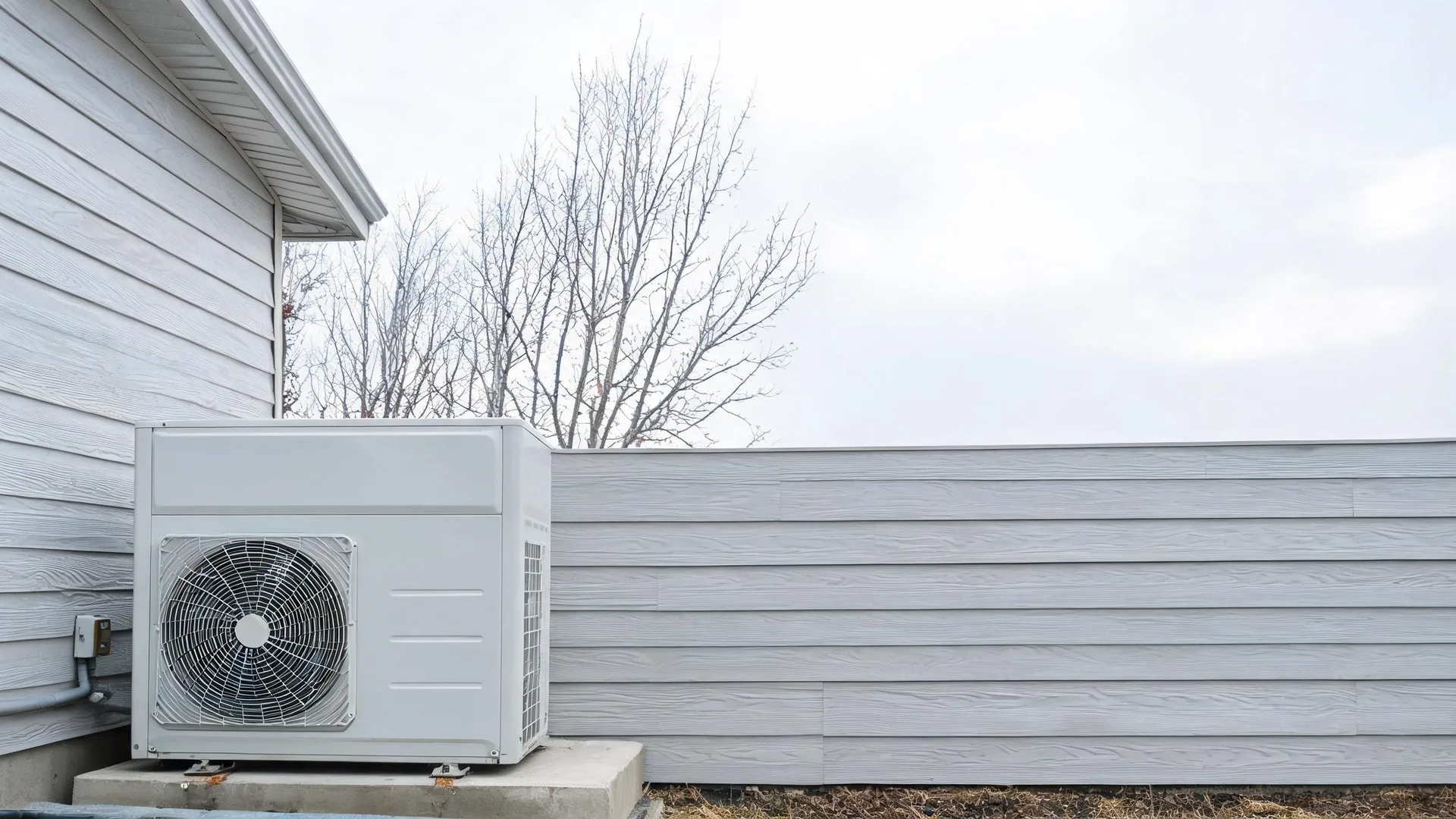
A residential heat pump outdoor unit mounted on a concrete pad next to a house with gray vinyl siding.

One visit a year, on your terms

A yearly check is maintenance, not repair. Someone looks at refrigerant charge, tests the capacitor, cleans the coil, confirms the reversing valve switches both ways. Nothing gets replaced unless it's already failing. That's a different visit than the one you get when the system is down and a part has to come out that day. Starting the yearly check now, while the system still has years ahead of it, is what keeps most visits the easy kind.

Keep the outdoor unit clear

The outdoor unit needs air moving through it on every side. Leaves, grass clippings, mulch, anything piled against the cabinet makes the coil work harder to pull in air, and that shows up as weaker heating or cooling. Walk around it now and then and clear away anything that's built up against the sides or sitting on top.

Change the filter, leave the rest alone

A dirty filter is the one thing between visits that actually causes trouble, since it chokes off airflow and makes the whole system strain. Check it on a schedule and swap it when it's gray instead of white. Past that, leave the refrigerant lines, the electrical panel and the inside of the cabinet to a technician. Opening those up without the right gauges and training causes more harm than the dust ever would.

A visual check from the ground tells you if the coil looks clean and the unit sits level. It doesn't tell you what the refrigerant pressure is doing, or whether the contactor's points are pitted from months of cycling on and off. A technician hooks up gauges and reads the charge against what the system is supposed to carry. Too little and the system is already working harder than it looks like it is. They'll also check the amp draw on the compressor, since a motor pulling more current than it should is a motor on its way out. None of that shows up by watching the air come out of the vent.

A tune-up on a heat pump means going through the system in both directions, since it has to move heat in and heat out depending on the season. That means checking the reversing valve under actual operation, not just confirming it has power, because a valve that's sticking will still take a signal and just not switch all the way. The technician checks static pressure across the air handler too, which tells them if the ductwork or a clogged coil is restricting airflow in a way the blower is straining to overcome. Electrical connections get checked for looseness and corrosion, since a connection that's heating up at the lug is a connection that eventually arcs or fails outright. The outdoor fan motor gets tested under load, not just switched on, because a motor can spin freely with no resistance and still not hold up once it's pulling air against a dirty coil. Every part of this is about catching what's drifting out of spec before it turns into what's broken.