White colonial houses with lit windows and dark shutters line a tree-lined street at dusk, bordered by dry-stacked stone walls.

Heat Pump Installation in Cambridge, MD

Tell us about the job

Takes about a minute. No obligation.

New system or replacementHeat PumpDorchester County, MD
Step 1 of 2

What ZIP code is the job in?

Electricity runs 17.86 cents a kilowatt-hour here

Maryland's power costs more than in most states. A heat pump moves heat instead of burning gas to make it, so it uses electricity for every degree it delivers. That rate applies to every kilowatt-hour your new system pulls.

The efficiency rating is what you're buying

Two heat pumps can heat and cool the same house and use different amounts of power doing it. At this rate, that difference shows up on every bill from the first month on, not just over the life of the system.

7 months
October through April, your system heats
4 months
June through September, it cools
29°F
the average winter night it heats against
86°F
the average summer afternoon it cools against
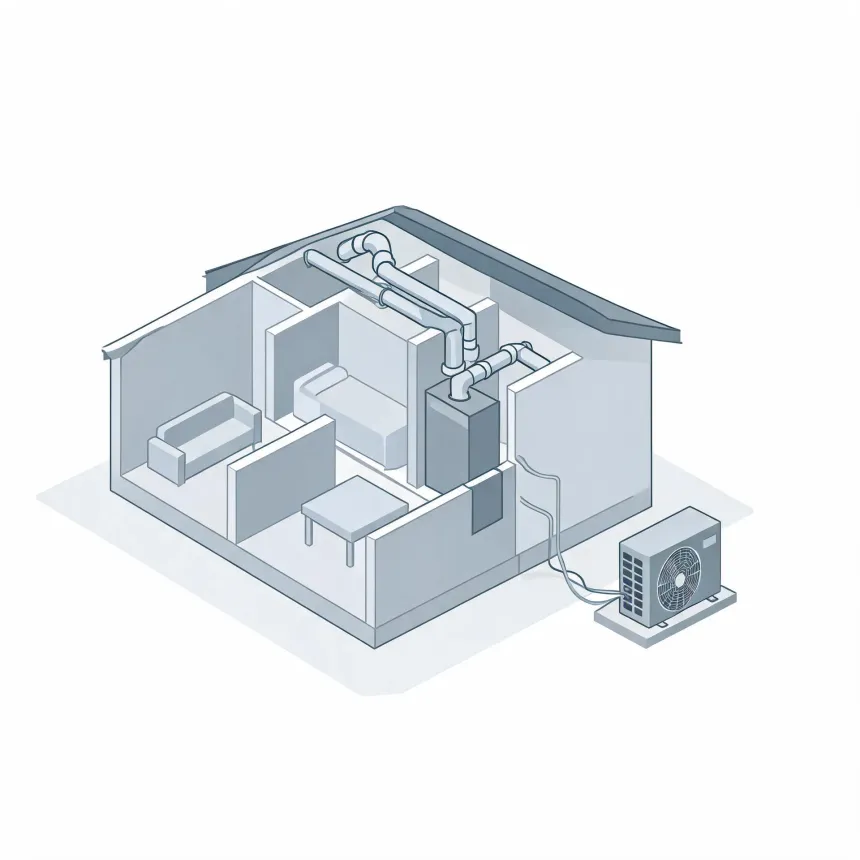
Isometric line illustration of a cutaway house showing interior rooms with furniture, ceiling ductwork connected to an indoor air handler, and a line running outside to an outdoor condenser unit.
Your system heats October through April and cools June through September.

NOAA nClimDiv, 1991–2020 normals

Half the homes in Dorchester County were built in 1975 or earlier, half later.

Neither age calls for anything other than a standard size and efficiency.

Heat runs seven months here, cooling four, so the old system is working most of the year

Cooling runs June through September
Heat runs October through April
58 damaging wind events from 2015 to 2024
Mixed cold winters, humid summers, nothing extremeOvernight lows average 29°F in winter here, with no stretch of brutal cold driving the load

More than half the homes in Dorchester County heat with electricity already, 53.1% by the county's count. The rest mostly run on fuel oil or propane, delivered and stored in a tank on the property. A heat pump fits right into a home that already heats electric, since it runs on the same fuel and often the same panel and circuit as the old system. For a home on oil or propane, switching means losing the tank and the delivery, and running the whole heating load through the electric panel instead. Either way, the panel and the circuit are the first things a contractor checks before anything gets installed.

A new system here has to meet zone 4A, and a credit is available for it

Any heat pump installed here now has to hit 14.3 SEER2 and 7.5 HSPF2, the federal minimum as of 2023. Dorchester County sits in climate zone 4A, a mix of real heat and real cold, so the system going in has to handle both. That floor on efficiency is already set. A federal tax credit is available on top of it for qualifying equipment.

Find a contractor
A gray outdoor HVAC unit mounted on a concrete pad beside a house with gray lap siding and a stone foundation.

Steady work, not hard work

The weather here doesn't push a system hard in either direction. Winter lows average 29°F, not the deep cold that drives a compressor to its limit, and summers here run humid rather than brutal. That's less strain on the equipment over the years it runs. It also means the federal minimum efficiency already required for this zone is a sound place to land, not a floor to build past. Put the money into getting the size right for the house instead.

The size of the job sets the price

A straight swap, same spot, same line sets, same electrical, costs less than a change. Moving the outdoor unit, running new line sets, or putting in a different kind of indoor unit all add labor and material before the equipment itself is even counted. The more the new system follows the path of the old one, the less there is to build.

The electrical work can cost more than the unit

A heat pump draws power the old gas or oil furnace never did, and some homes need a larger breaker, a new circuit, or a panel upgrade to carry it. That work falls to a licensed electrician, priced and scheduled apart from the heat pump install itself. A contractor who checks the panel early catches this before it becomes a surprise partway through the job.

A heat pump sized for the house runs long, steady cycles that hold the temperature even. One sized too big shuts off and on before it ever settles into that steady run, which wears the compressor and leaves the air clammy in summer since it never runs long enough to pull the moisture out. One sized too small runs flat out and still can't keep up on the coldest or hottest days. Getting it right starts with a room by room heat loss and heat gain calculation, not the size of the unit coming out. That calculation looks at the square footage, the windows, the insulation, and how the place is laid out, and it's what tells a contractor which size actually matches the house instead of guessing from the old equipment.

Install day starts with the outdoor unit and indoor air handler or coil, then the line sets connecting them get run, brazed, and pressure tested for leaks before anything is charged with refrigerant. The old equipment comes out first if it's a replacement, and the crew checks the existing line sets and pad to see what can stay and what has to go. Electrical work happens alongside the mechanical work, since the new unit needs its own circuit and disconnect box, sized to what the equipment actually draws. Once everything is connected, the system gets evacuated to pull moisture and air out of the line set before refrigerant goes in, because either one left behind will damage the compressor over time. Then it's charged to the manufacturer's spec, started up, and run through its paces, heating and cooling, so the contractor can check temperatures at the vents and confirm the thermostat is talking to the system the way it should.